
Unlocking Market Advantage
Indonesia’s Pathway in the Evolving Critical Minerals Landscape
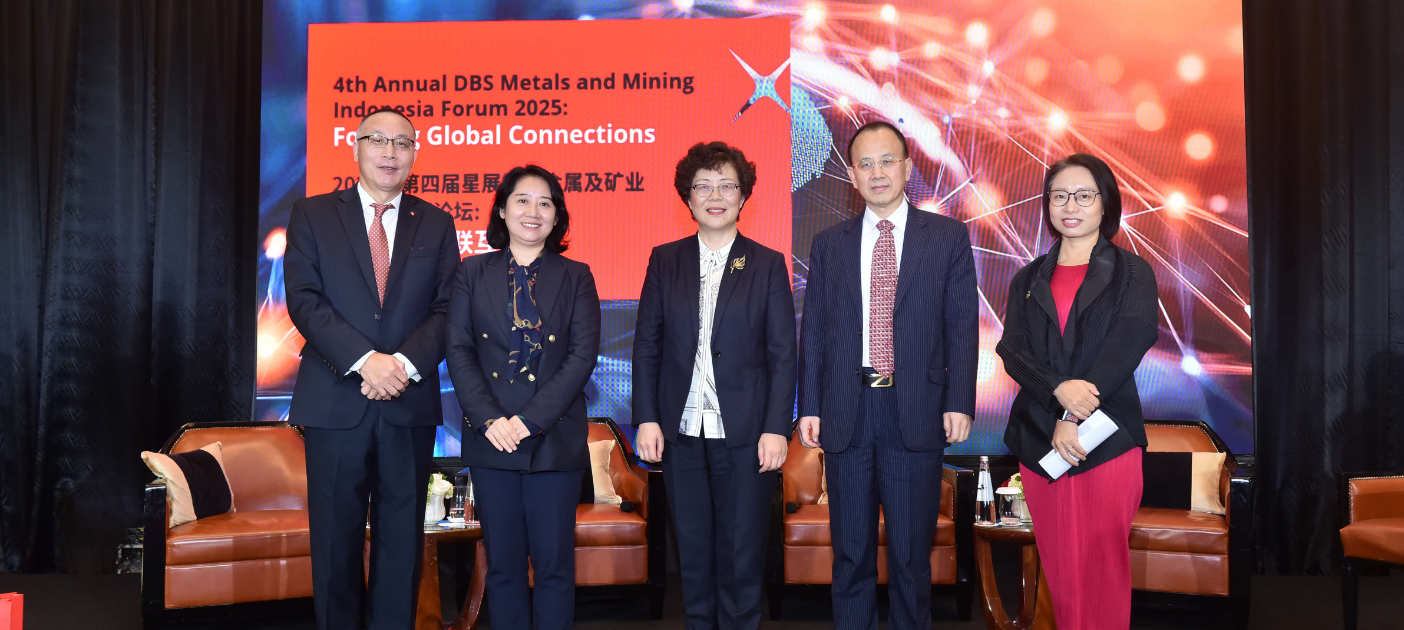

At the 4th Annual DBS Metals and Mining Indonesia Forum 2025: Forging Global Connections, the panel discussion “From Resource to Market: Capitalising on Critical Minerals Advantage” marked a distinct highlight of the forum, bringing together international experts who travelled specifically to Jakarta to share global perspectives with a group of key regional metals and mining industry players. The session convened three highly regarded specialists: Xu Aidong, Chief Analyst at Antaike and Consultant to the China Nonferrous Metals Industry Association (CNIA) Nickel and Cobalt Branch, whose work closely tracks China’s metals demand and pricing dynamics; David Bo, Independent Director at Zijin Mining Group and author of Ins and Outs of International Mining, with extensive experience across global mining investment cycles; and Rachel Xia, Partner at Zhong Lun Law Firm, a leading adviser on cross-border transactions and regulatory frameworks in the natural-resources sector. The discussion was moderated by Li Xin, Vice-President of Caixin Media and Managing Director of Caixin Global.
Their discussion reflected a shared global reality. As electrification, automation, and low-carbon development accelerate, the minerals that underpin batteries, semiconductors, and advanced manufacturing have become central to economic strategy. Indonesia, home to the world’s largest nickel reserves and an increasingly influential stainless-steel industry, now sits at a critical intersection of these structural shifts.

David Bo opened the conversation by emphasising the cyclical nature of the mining industry. He observed that the sector has entered a new up-cycle characterised by stronger investor appetite and expanding capital flows. Large mining companies have seen substantial share-price appreciation over the past 12–18 months. At the same time, junior miners—often early indicators of improving market sentiment—are now raising significantly larger funding rounds, in many cases increasing from US$2–3 million per financing 6 months ago to US$20–50 million now. This renewed liquidity reflects several key factors. Gold's prominence is underscored by the unsustainability of global debt, central bank reserve diversification, and geopolitical and trade uncertainties, while copper's value is driven by confidence in long-term demand stemming from energy transition, artificial-intelligence-related infrastructure, and global industrial upgrading.

Within this shifting landscape, Indonesia’s policy direction plays a defining role. Over the past decade, the country has moved away from ore-export dependence and towards a more integrated downstream-industrial strategy. Xu Aidong explained that Indonesia’s downstreaming policy, first introduced in 2009, has reshaped global nickel markets. Indonesia is now the world’s largest nickel producer, the second-largest stainless-steel producer, and a rapidly growing contributor to electric-vehicle (EV) precursor materials. Chinese investment, technology transfer, and market scale have enabled the development of integrated industrial ecosystems at a pace rarely seen in other resource-producing countries.
This progress opens up new opportunities for Indonesia to shape the global nickel market, now supplying more than 65 per cent of global output in certain product categories. As Indonesia’s policies evolve, they can cause far-reaching impact on global prices, supply dynamics, and investor confidence. Market participants actively engage with Indonesia’s regulatory updates, recognising the country’s pivotal role in ensuring a stable and forward-looking market environment.”

From a legal and regulatory perspective, Rachel Xia emphasised Indonesia’s dynamic investment environment, which encourages foreign investors to engage deeply and build strong local and long-term partnerships. The country’s comprehensive licensing framework and evolving policies are designed to foster responsible growth and long-term value creation. Significant investments in smelting projects—often ranging from US$1–2 billion—requiring world-class standards and thorough due diligence. Xia also highlighted that success in Indonesia increasingly depends on understanding local commercial practices, embracing robust ESG standards, and nurturing positive community relations, all of which contribute to sustainable and mutually beneficial outcomes.

Technology, partnership quality, and capital discipline emerged as consistent themes across the discussion. Bo pointed to the role of advanced technologies such as high-pressure acid leach (HPAL), which can help reduce capital intensity and operating costs, making large-scale processing projects more competitive. Xu and Xia further emphasised the value of strong partnerships with local stakeholders to ensure regulatory clarity, cultural alignment, and operational stability.

The session concluded with a clear message for global investors: Indonesia’s critical-minerals sector offers exceptional opportunities for those ready to collaborate, innovate, and invest for the long term. By maintaining policy consistency, fostering international partnerships, and leveraging technology-driven efficiencies, Indonesia is well positioned to realise its full potential as a global leader. The country’s dynamic landscape welcomes investors who are proactive, adaptable, and committed to building lasting value.

