
- Despite sharp rise in interest rates, the world has avoided a recession.
- The banking system has proved largely resilient, while capital flows have not dried up.
- Cost of living is nonetheless a major risk for social stability.
- Commercial real estate sector losses could trip up the financial system.
- High correlation among asset markets is a concern, along with large investments in private market.

Commentary: Global shocks and resilience
Overall tone
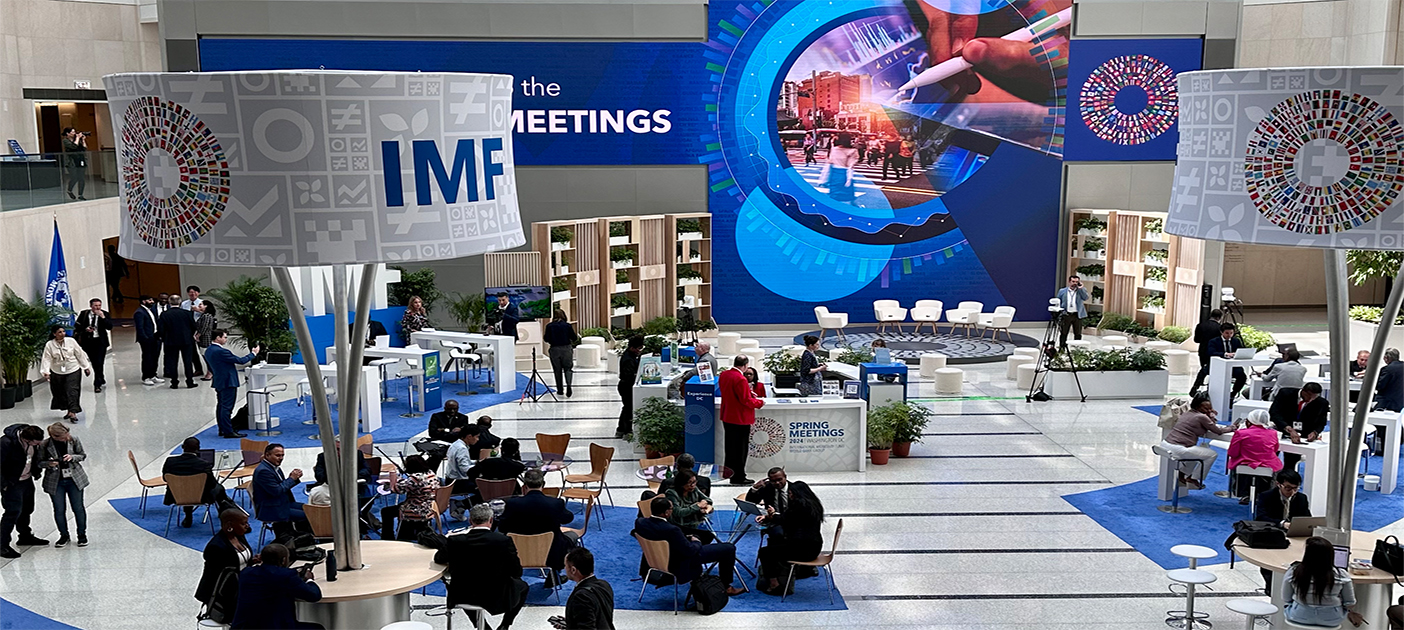
Last week’s annual meetings of the IMF and the World Bank, held in Washington, DC, had a hint of relief with respect to global economic and financial risks. Policy makers have spent more than two years fearful of a bumpy recovery from the Covid pandemic. But despite a sharp rise in interest rates, the world has avoided a recession, the banking system has proved largely resilient, while capital flows have not dried up. The 2021/22 inflation spurt has been followed by an encouraging period of disinflation, even if consumers are dissatisfied with the high level of some prices.
The IMF updated its growth-at-risk framework analysis, which indicated some decrease in near-term financial stability risks, which by extension points to a lessening of GDP growth risks this year.
But policy makers are not devoid of worries. Concerns remain about the steady extension of the higher-for-longer narrative, with rate cut expectations softening against the strong growth and sticky inflation narrative. A key concern is the commercial real estate (CRE) sector, where real prices have declined by 12% globally over the past year. The distress in the sector is a function of factors that are both cyclical (rising interest rates) and structural (work from home). This weakness is most pronounced in the US and Europe.
A wide range of risk metrics suggests that banks are well-positioned to absorb CRE losses, Nonetheless, certain countries may experience more strains given that their banks hold large amounts of CRE loans, especially if demand remains weak.
Another area of concern is the high level of correlation across asset classes. As per analysis done by the IMF’s financial sector experts, average correlation across equities, bonds, credit, and commodity indices in both advanced economies and emerging markets presently exceeds the 90th historical percentile. Hence, financial shocks, including sizable inflation surprises that change investor sentiment, could cause across-the-board asset selloffs.
The list of concerns does not end there. During the meetings, we heard warnings about China’s property market, ultra narrow credit spreads, DM debt market, Chinese and US banks, and the consequence of further quantitative tightening.
A section of the IMF’s Global Financial Stability Report was focused on the nonbank financial sector. Open-end bond funds, including ones focused on less liquid assets, have received large inflows in recent years, with relatively less visibility on the vulnerabilities this development may have caused.
View from US officials
- Secretary Yellen's China trip in early April was useful in deepening dialogue with the Chinese authorities. Both sides were engaged, while many areas of disagreement remain. The media has covered the trip extensively, but did not adequately capture the constructive nature of the trip.
- Yellen's argument that China's manufacturing overcapacity is creating global deflation risks is something the Treasury feels strongly about, and it wants the IMF to examine it from a multilateral perspective. The key evidence cited by the US Treasury is that China's industrial production and industrial policy are structurally misaligned from domestic demand. Consumption boosting policies ought to help ameliorate such imbalances.
- US officials are also concerned about currency misalignment and associated financial stability risks around global markets. The recently published Japan-Korea-US ministerial statement underscored this concern, with explicit reference to the yen and won’s recent depreciation. China’s currency practice remains under scrutiny, including the data on reserves and balance of payments that are providing inadequate insights into external account dynamics.
- US officials tend to push back on concerns that US fiscal debt and deficit path pose systemic risk to the US or beyond. There remains considerable dearth of safe assets in this world, keeping US debt issuance well-bid. This dynamic is unlikely to change in the coming years.
- The Treasury and the Department of Commerce are examining the “rules of origin” around China’s offshoring of production. It is clear that some of the US imports from Mexico/Vietnam and a few other countries have substantial Chinese inputs and capital.
View from IMF staff
- The IMF is not in alignment with the US government’s push to examine China’s “overcapacity.” The fact that China is a major exporter of a wide variety of manufactured products, some of which are facilitated by industrial policy, is hardly a China-specific or a new phenomenon. Also, China’s current or trade account trends in recent years don’t reflect chronic or rising surpluses, which renders arguments related to overcapacity or exporting of deflation impulse non-tenable.
- The IMF does not consider the USD misaligned. The current account does not appear to be widening, nor is it away from the medium-term trend. It is plausible to consider US debt path as a risk to the dollar going forward, but even that seems like a stretch after two factors are considered: (i) USD’s privilege as a reserve currency and (ii) the persisting dearth of safe assets globally.
- In any case, a path toward fiscal adjustment is much surer way to rebalance the US economy than through a depreciation of the dollar, which is the more likely path of adjustment for an EM economy.
- On inflation and Fed, the IMF staff are quite relaxed. They expect inflation to ease up in the coming months on the back of rentals and fading of one-offs like auto insurance. They still see the Fed cutting rates 2-3 times in 2H24, and by 4-5 times in 2025. The expectation is neutral rate will be revised up to 3%, and the cycle can settle around that by early 2026.
To read the full report, click here to Download the PDF.


Topic
GENERAL DISCLOSURE/ DISCLAIMER (For Macroeconomics, Currencies, Interest Rates & Digital Assets)
The information herein is published by DBS Bank Ltd and/or DBS Bank (Hong Kong) Limited (each and/or collectively, the “Company”). It is based on information obtained from sources believed to be reliable, but the Company does not make any representation or warranty, express or implied, as to its accuracy, completeness, timeliness or correctness for any particular purpose. Opinions expressed are subject to change without notice. This research is prepared for general circulation. Any recommendation contained herein does not have regard to the specific investment objectives, financial situation and the particular needs of any specific addressee. The information herein is published for the information of addressees only and is not to be taken in substitution for the exercise of judgement by addressees, who should obtain separate legal or financial advice. The Company, or any of its related companies or any individuals connected with the group accepts no liability for any direct, special, indirect, consequential, incidental damages or any other loss or damages of any kind arising from any use of the information herein (including any error, omission or misstatement herein, negligent or otherwise) or further communication thereof, even if the Company or any other person has been advised of the possibility thereof. The information herein is not to be construed as an offer or a solicitation of an offer to buy or sell any securities, futures, options or other financial instruments or to provide any investment advice or services. The Company and its associates, their directors, officers and/or employees may have positions or other interests in, and may effect transactions in securities mentioned herein and may also perform or seek to perform broking, investment banking and other banking or financial services for these companies. The information herein is not directed to, or intended for distribution to or use by, any person or entity that is a citizen or resident of or located in any locality, state, country, or other jurisdiction (including but not limited to citizens or residents of the United States of America) where such distribution, publication, availability or use would be contrary to law or regulation. The information is not an offer to sell or the solicitation of an offer to buy any security in any jurisdiction (including but not limited to the United States of America) where such an offer or solicitation would be contrary to law or regulation.
[#for Distribution in Singapore] This report is distributed in Singapore by DBS Bank Ltd (Company Regn. No. 196800306E) which is Exempt Financial Advisers as defined in the Financial Advisers Act and regulated by the Monetary Authority of Singapore. DBS Bank Ltd may distribute reports produced by its respective foreign entities, affiliates or other foreign research houses pursuant to an arrangement under Regulation 32C of the Financial Advisers Regulations. Where the report is distributed in Singapore to a person who is not an Accredited Investor, Expert Investor or an Institutional Investor, DBS Bank Ltd accepts legal responsibility for the contents of the report to such persons only to the extent required by law. Singapore recipients should contact DBS Bank Ltd at 65-6878-8888 for matters arising from, or in connection with the report.
DBS Bank Ltd., 12 Marina Boulevard, Marina Bay Financial Centre Tower 3, Singapore 018982. Tel: 65-6878-8888. Company Registration No. 196800306E.
DBS Bank Ltd., Hong Kong Branch, a company incorporated in Singapore with limited liability. 18th Floor, The Center, 99 Queen’s Road Central, Central, Hong Kong SAR.
DBS Bank (Hong Kong) Limited, a company incorporated in Hong Kong with limited liability. 11th Floor, The Center, 99 Queen’s Road Central, Central, Hong Kong SAR.
Virtual currencies are highly speculative digital "virtual commodities", and are not currencies. It is not a financial product approved by the Taiwan Financial Supervisory Commission, and the safeguards of the existing investor protection regime does not apply. The prices of virtual currencies may fluctuate greatly, and the investment risk is high. Before engaging in such transactions, the investor should carefully assess the risks, and seek its own independent advice.