
How Warehouses Are Using AI To Optimise Their Inventory
How AI is quietly reshaping logistics and wholesale, and why the smartest operators are moving now
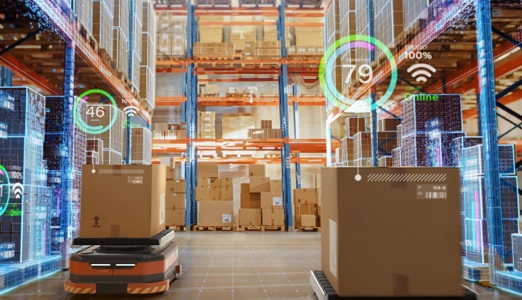
By the time a consumer clicks "add to cart," the most forward-thinking wholesalers have already anticipated the order. Across the logistics and wholesale sectors, AI is enabling a quiet but profound shift: the ability to predict demand before it materialises, route shipments before delays occur, and replenish shelves before they empty. According to McKinsey, organisations that have embedded AI into supply chain operations have seen logistics costs reduce by up to 15%, inventory levels tighten by as much as 35%, and service levels rise by 65%. These are not marginal gains. They represent a fundamental change in how goods move from origin to consumer.
The shift is already underway. About 57% of businesses in Singapore are prioritising AI adoption, the highest rate in Asia, and the local AI-in-logistics market alone is valued at USD 1.2 billion. That momentum signals enormous opportunity, but also urgency: the gap between early movers and the rest is widening fast.
The Pressures Reshaping the Industry
Freight demand is getting harder to predict. A single shipment might be booked on one carrier, rerouted when a port backs up, then rescheduled after a missed window. Traditional forecasting models that were built on historical averages and manual overrides struggle to keep up. The result is a familiar headache: capacity sitting idle on one lane, and shipments stranded on another.
Logistics networks are under similar strain. Cross-border trade brings regulatory requirements that shift by lane and product, while last-mile delivery costs keep climbing as consumers expect faster fulfillment. Singapore’s freight and logistics market is projected to reach SGD 45 billion by end-2031, but the operational complexity around returns processing and inventory balancing erodes profits for growing businesses.
But AI is slowly changing this.
Four AI Applications Already Proving Their Worth
The first is intelligent demand forecasting. AI engines can now pull in weather data, local events, social media trends, and promotional schedules to build a more detailed picture of what customers are likely to buy, and when. Businesses using these systems have seen stockouts drop up to 30% which means fewer missed sales and more consistent revenue.
The second is dynamic route optimisation. Instead of relying on fixed delivery schedules, an AI can calculate routes in real time based on traffic, weather, and vehicle capacity. For example, a US delivery company optimises routes by just one mile per driver per day across its fleet, saving the company an estimated USD 50 million annually. For mid-sized operators navigating Singapore’s dense urban roads, even modest improvements in routing can translate into meaningful savings.
The third is quality and safety monitoring. AI systems can summarise customer reviews and complaints to surface product issues early, while scanning transaction data for patterns like repeat return abuse or bulk-order fraud. The same tools generate standardised labelling and regulatory disclosures, keeping listings compliant without manual review of every SKU.
Fourth is warehouse capacity optimisation. AI analytics can unlock 7 to 15% additional capacity within existing networks, not by expanding physical space, but by spotting underused areas and rebalancing workloads. In one case documented by McKinsey, a major building products distributor improved fill rates by 5 to 8% after deploying an AI-enabled control tower across its facilities.
The Compounding Advantage
What ties these applications together is a single idea: the businesses that will thrive are those that can sense and respond faster than the market moves. AI does not replace human judgment: it sharpens it, by surfacing risks sooner and turning operational data into decisions that can be acted on in hours rather than weeks.
Locally, the momentum is real but uneven. According to the latest DBS Business Pulse Check Survey, while 67% of Singapore SMEs are already applying some form of AI, only 12% have fully integrated it across their operations. The survey also found that financial support or grants (44%) are the most sought-after form of support for AI adoption, followed by expert advice and technology partnerships. Of these SMEs, wholesale and trade businesses are the least likely of any sector to have adopted AI solutions, underscoring just how much ground is still up for grabs.
For businesses in Singapore, where supply chains are a lifeline and efficiency is non-negotiable, the DBS Spark GenAI Programme offers structured support to close that gap. Developed with Enterprise Singapore and the Infocomm Media Development Authority (IMDA), the programme helps businesses discover relevant use cases, get matched with solutions, and access grants to lower the barriers to adoption.
The warehouse of the future will not simply store goods. It will anticipate what is needed, when, and where. The businesses that recognise this early will not just keep pace. They will set it.
Ready to explore how Gen AI can transform operations? Sign up for the DBS Spark GenAI Programme to discover use cases, get matched with solutions, and access grants to kickstart adoption.
Sources
- DataRobot, “AI in Supply Chain — A Trillion Dollar Opportunity,” citing McKinsey data on logistics cost, inventory, and service level improvements. https://www.datarobot.com/blog/ai-in-supply-chain-a-trillion-dollar-opportunity/
- FedEx, “AI and Sustainable Logistics in Singapore Supply Chains,” citing 57% AI prioritisation rate and Logistics ITM 2025 projections. https://www.fedex.com/en-cn/business-insights/tech-innovation/ai-sustainable-logistics-singapore-supply-chains.html
- Ken Research, “Singapore AI in Logistics and Ports Market,” October 2025, citing USD 1.2 billion market valuation. https://www.kenresearch.com/singapore-ai-in-logistics-and-ports-market
- Mordor Intelligence. "Singapore Freight and Logistics Market Size, Trends & Growth 2025–2031." Mordor Intelligence, www.mordorintelligence.com/industry-reports/singapore-freight-and-logistics-market. Accessed 17 Sept. 2026.
- McKinsey & Company, “From Cost Center to Competitive Advantage: Modernising Reverse Logistics with AI,” February 2026. https://www.mckinsey.com/industries/logistics/our-insights/from-cost-center-to-competitive-advantage-modernizing-reverse-logistics-with-ai
- McKinsey & Company, “Beyond Automation: How Gen AI is Reshaping Supply Chains,” April 2025. https://www.mckinsey.com/capabilities/operations/our-insights/beyond-automation-how-gen-ai-is-reshaping-supply-chains
- McKinsey & Company, “Harnessing the Power of AI in Distribution Operations,” November 2024, citing 7-15% additional capacity. https://www.mckinsey.com/industries/industrials/our-insights/distribution-blog/harnessing-the-power-of-ai-in-distribution-operations
- BSR, “Looking Under the Hood: ORION Technology Adoption at UPS,” citing USD 50 million per-mile savings. https://www.bsr.org/en/case-studies/center-for-technology-and-sustainability-orion-technology-ups
- "AI Retail 2026: How Artificial Intelligence Transforms Shopping." Articsledge, citing stockouts can drop up to 30%. www.articsledge.com/post/ai-retail
- IMDA, “Singapore’s Digital Economy at 18.6% of GDP,” October 2025, citing SME AI adoption and PSG cost savings data. https://www.imda.gov.sg/resources/press-releases-factsheets-and-speeches/press-releases/2025/singapore-digital-economy
- Aristek Systems, “AI 2025 Statistics,” citing McKinsey survey data on distributor AI exploration. https://aristeksystems.com/blog/whats-going-on-with-ai-in-2025-and-beyond/
